Early AKI Bio significance
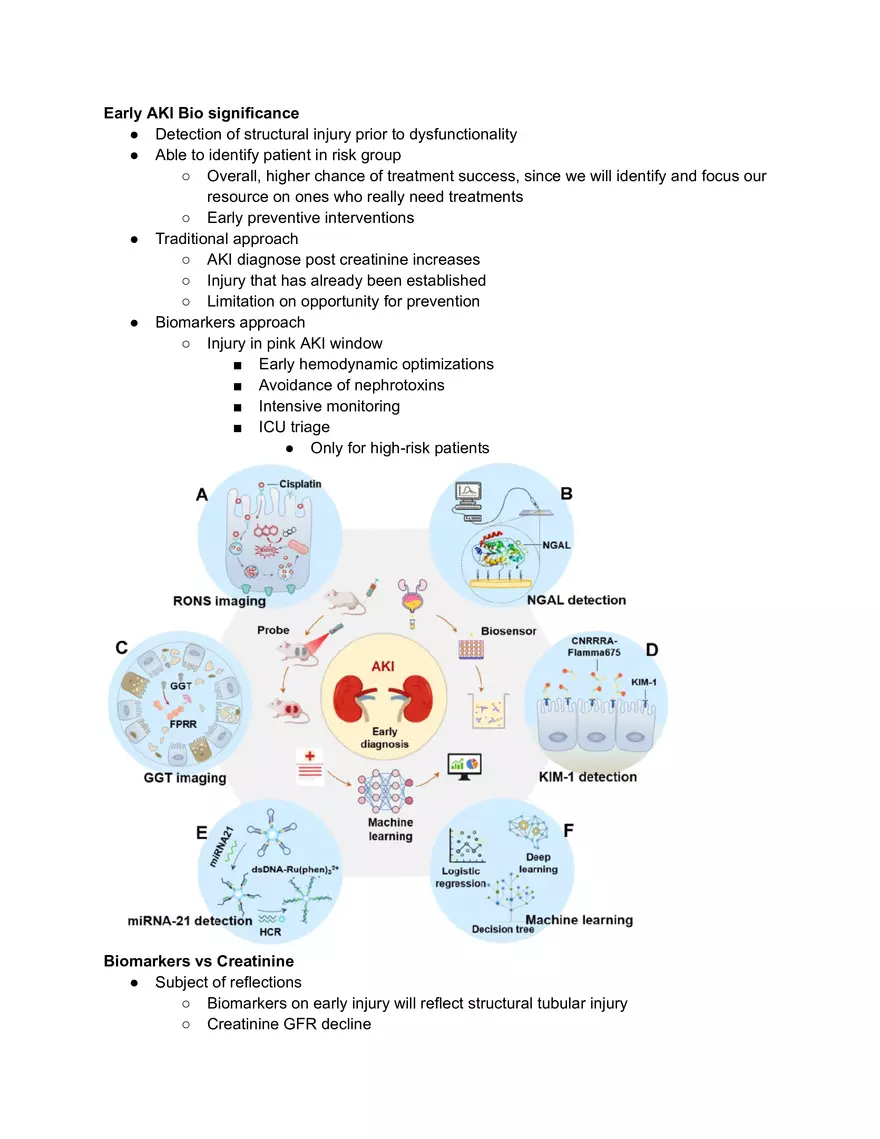
● Detection of structural injury prior to dysfunctionality
● Able to identify patient in risk group
○ Overall, higher chance of treatment success, since we will identify and focus our
resource on ones who really need treatments
○ Early preventive interventions
● Traditional approach
○ AKI diagnose post creatinine increases
○ Injury that has already been established
○ Limitation on opportunity for prevention
● Biomarkers approach
○ Injury in pink AKI window
■ Early hemodynamic optimizations
■ Avoidance of nephrotoxins
■ Intensive monitoring
■ ICU triage
● Only for high-risk patients
Biomarkers vs Creatinine
● Subject of reflections
○ Biomarkers on early injury will reflect structural tubular injury
○ Creatinine GFR decline ● Time of rise
○ Hours after insult
■ Biomarkers
○ 24-48hr
■ Creatinine
● Sensitivity
○ Tends to be higher on early injury for biomarkers
○ Low and late marker for creatinine
● Specificity
○ Moderate (biomarker)
○ High (creatinine)
■ Reduced GFR
● Prognostic value
○ In early injury biomarkers are strong
○ Limited for creatinine
Creatinine will increase post-nephron loss
Some patients have despite recovery
● Normalization of creatine
● Subclinical fibrosis
● Biomarker in stable or mildly elevated
○ This will explain on delayed CKD developments
● Functional recovery does not mean its structural recovery
● Hidden injury phase
○ Early AKI window
■ Renal tubular cells will be…
● Stressed
● Dedifferentiating
● Cell-cycle arrest
■ Non-measurable changes in creatinine
○ Biomarkers such as NGAL,KIM-1, IL-18, TIMP-2/IGFBP-7 will detect structural
injury and cellular stress
■ Increase in hours
■ Revealing AKI on functional decline
○ Biomarkers will sense hidden injury
● Reactive traditional
○ Insult occurs
○ Creatinine increases
○ AKI
○ But damage already done
Limited ability on reserving injury
● Preventive model
○ Insult occurs
○ Biomarker increases ○ Early intervention in injury phase
○ Reduced progression